Some pieces of furniture decorate a room. Others tell the story of an era. The club chair does both. With its enveloping lines, beautifully aged leather, and instant comfort, it has embodied a certain idea of understated luxury, French refinement, and furniture made to last for more than a century.
An icon of French furniture, the club chair has crossed generations without losing its impact. It appeals equally to interior design lovers and to those who appreciate fine materials, craftsmanship, and antique furniture. In a living room, library, office, or contemporary interior, it naturally commands attention.
But behind this familiar silhouette lies a rich history. Born at the beginning of the 20th century, the club chair marked a major turning point in the history of seating: for the first time, comfort became the starting point of design. Where older armchairs favored appearance and posture, the club chair introduced a new relationship with furniture—more intimate, warmer, and more human.
In this complete guide, discover the history of the club chair, its origins, its evolution through the decades, its signature styles, its materials, the differences between antique models and modern reproductions, and the essential criteria for choosing a club chair today.
What is a club chair?
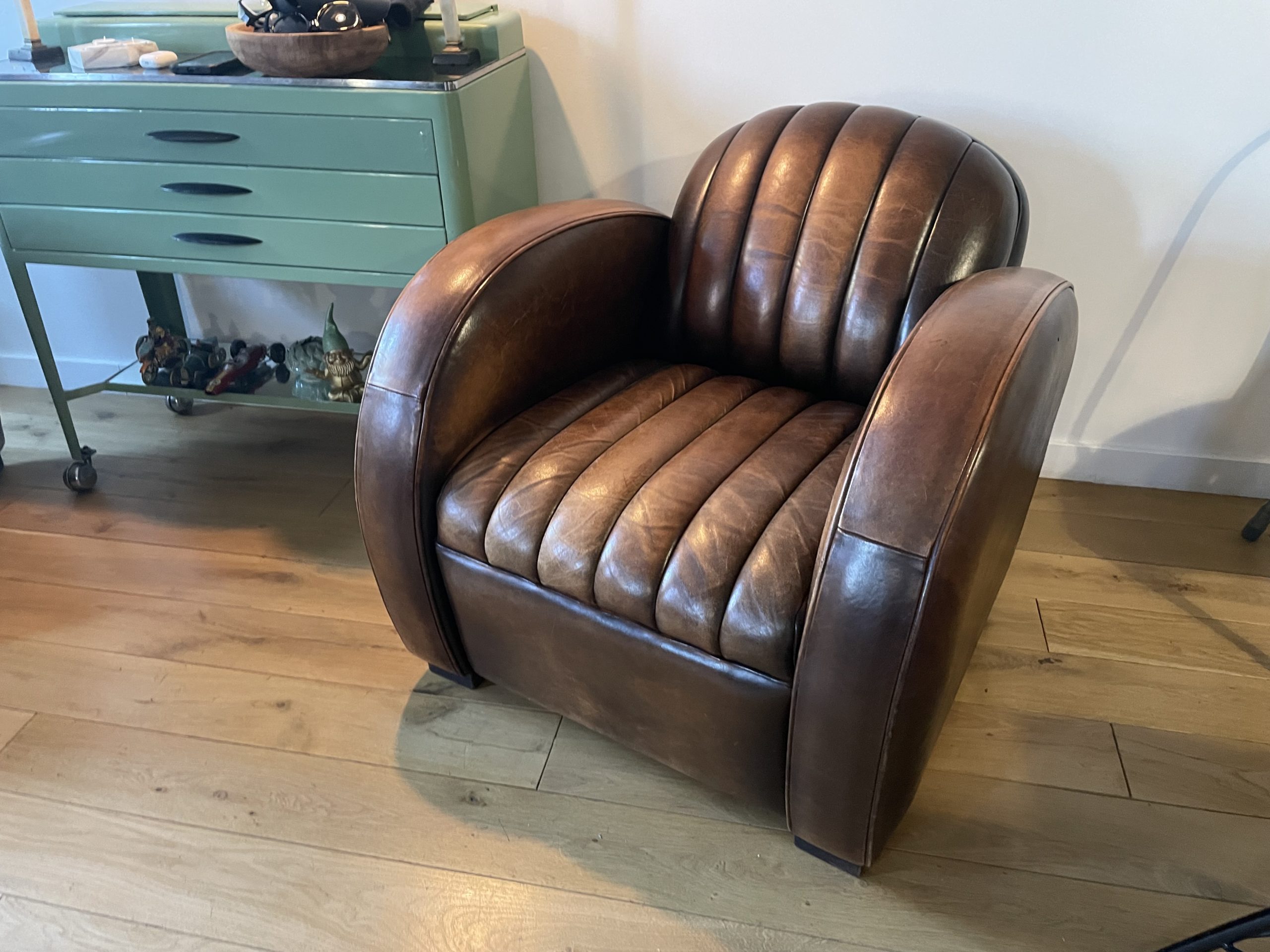
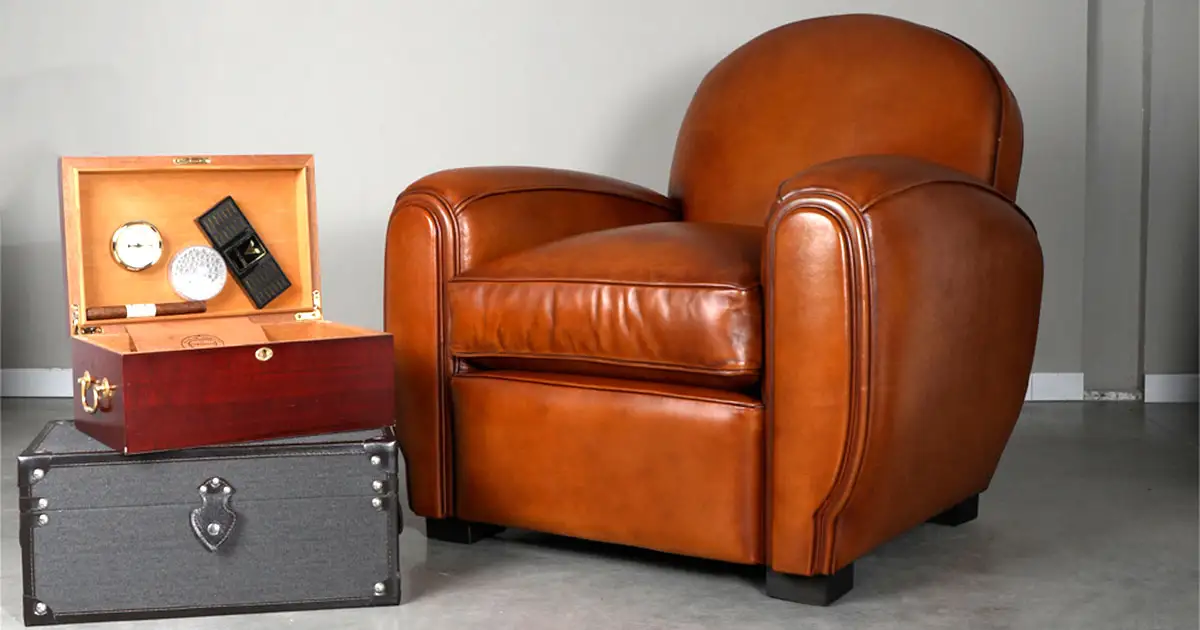
The club chair is a seat that appeared in France at the beginning of the 20th century. It stands out for its deep seat, low and enveloping backrest, generous armrests, and leather upholstery, often made from sheepskin leather or full-grain leather on high-quality models.
Its shape is designed for relaxation. Unlike the rigid armchairs of the 19th century, which were often more upright and decorative, the club chair invites you to settle in for the long haul. It accompanies reading, conversation, rest, and the simple pleasure of sitting without constraint.
The club chair is therefore not just an antique piece of furniture or a vintage leather armchair. It is an object that transformed the history of domestic comfort. Its compact, reassuring silhouette, its living leather, and its sturdy structure still make it a benchmark in the world of high-end furniture today.
The essentials of a club chair:
- A low, deep, and welcoming seat
- Rounded, enveloping shapes
- Noble leather that develops a patina over time
- A strong structure designed to last for decades
- An immediately recognizable visual identity
What is the origin of the club chair?
The origin of the club chair is rooted in changing lifestyles. At the turn of the 20th century, interiors were evolving. The living room became a central space in the home, devoted not only to formal entertaining but also to relaxation, conversation, and everyday comfort.
Craftsmen and makers began looking for ways to create more welcoming seats, capable of embracing the body and responding to a new expectation: living better at home. The club chair was born from this search. It broke away from visible frames, overly stiff lines, and severe seating, offering instead a full, soft, and generously upholstered form.
Leather quickly became the natural upholstery for this new chair. Durable, supple, breathable, and refined, it protected the structure while giving the chair a unique character. With use, it developed a patina that only enhanced its charm. It is this combination of comfort, craftsmanship, and living material that secured the club chair’s place in the history of French furniture.
The word “club” also evokes the world of English clubs, intimate lounges, and elegant conversation spaces. Yet the club chair as we know it established itself in France with a distinct identity, deeply connected to the French taste for leather, beautiful proportions, and furniture with character.
Club chair timeline
1900–1920: birth of the club chair and the first all-leather models
1930s: golden age, spread into elegant interiors, and diversification of forms
1950–1970: wider adoption, adaptation to new homes, and broader production
1980s: temporary decline in the face of contemporary design and synthetic materials
2000 to today: return of vintage style, authenticity, and durable furniture
How the club chair evolved over time
1900–1920: the birth of a new kind of comfort
The first club chairs appeared at the beginning of the 20th century. They answered a new demand: to create a softer, more enveloping, and more relaxing seat than traditional armchairs. This period laid the foundations of the authentic club chair: rounded shapes, thick leather, a solid wood frame, and generous padding.
The armchair gradually ceased to be merely a symbol of status. It became a functional piece of furniture, designed for the body and for long-term use. That may seem obvious today, but at the time it was a true revolution in the way furniture was conceived.
The 1930s: the golden age of the club chair
In the 1930s, the club chair reached its true golden age. It found its place in bourgeois living rooms, elegant offices, private mansions, prestigious halls, and refined reception spaces. Its image became fixed: that of a comfortable, noble, and warm seat, both stately and welcoming.
This was also the period in which stylistic variations developed. The lines became more refined, certain backrests took on more distinctive shapes, and models that are now highly sought after appeared. The club chair became an object of taste, at the crossroads of decoration, craftsmanship, and high-end comfort.
👉 Read about the evolution of the 1930s and 1940s
1950–1970: wider adoption and adaptation
After World War II, the club chair continued its journey into a wider variety of interiors. It was no longer reserved for prestigious settings alone. It entered family homes, apartments, professional offices, and more accessible decorative worlds.
Production diversified. Some models remained highly artisanal, while others became more standardized. The club chair kept its identity but adapted to broader uses. It was also during this period that materials and padding techniques began to evolve.
👉 See the evolution from 1950 to 1970
The 1980s: a temporary decline
In the 1980s, the club chair faced the rise of contemporary design. Straight lines, visible structures, bright colors, and synthetic materials appealed to a new audience. Against this more modern aesthetic, the club chair was sometimes seen as too traditional or too classic.
Yet it never disappeared completely. It remained present in interiors devoted to noble materials, in places with character, and among collectors of antique furniture. This period of retreat actually prepared the ground for its future comeback.
Since 2000: the return of the antique and vintage club chair
The beginning of the 21st century marked a real revival. People rediscovered the appeal of durable furniture, the elegance of aged leather, and the decorative power of authentic pieces. The club chair returned to the spotlight thanks to the taste for vintage style, craftsmanship, warm interiors, and objects with a story to tell.
Today, it is appreciated both in antique versions and in high-quality reproductions. It appeals to those looking for an antique club chair, a vintage leather club chair, French furniture, and interiors where material matters more than fleeting trends.
Craftsmanship and materials
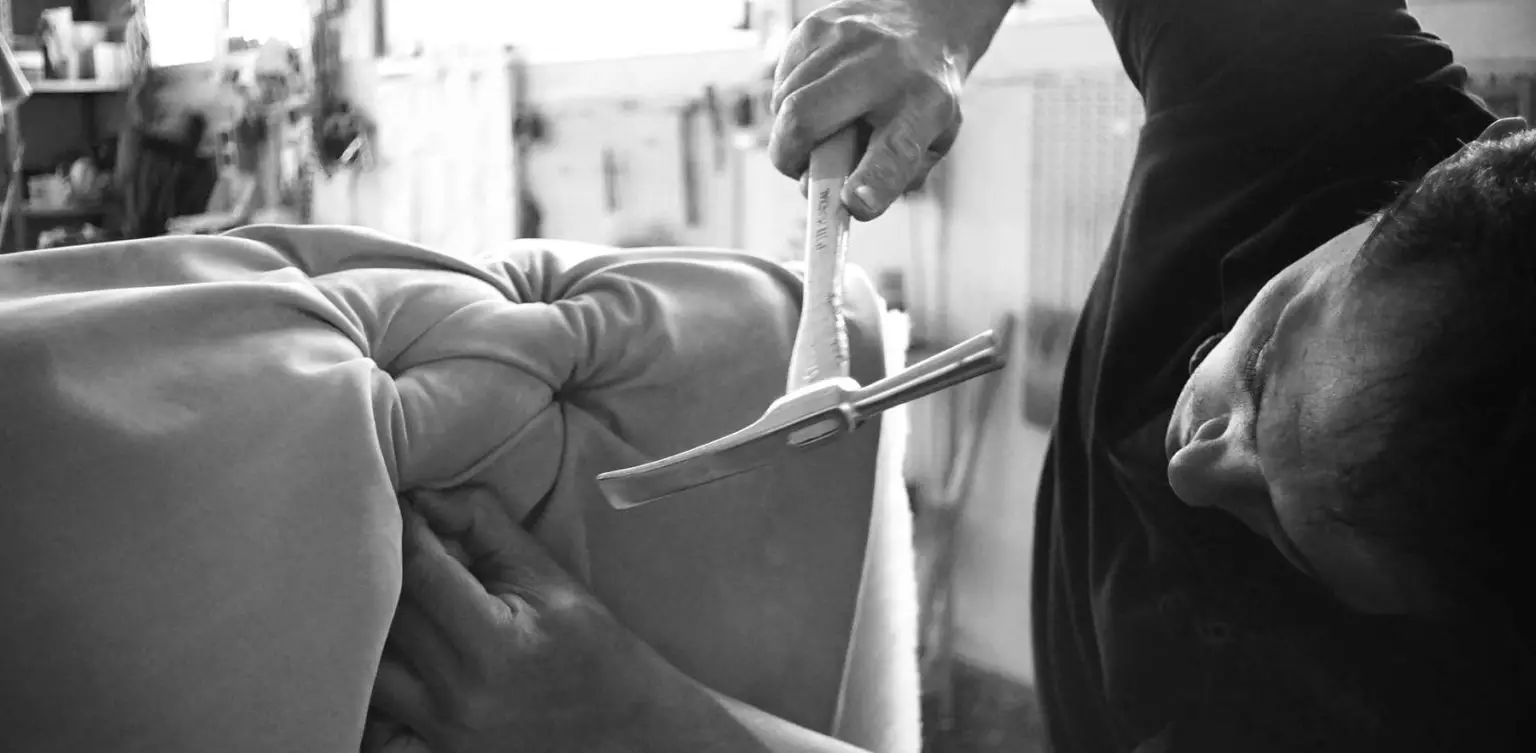
A true club chair relies on precise, often artisanal craftsmanship that determines its comfort, durability, and appearance. Behind its apparent simplicity lies an assembly of noble materials and carefully executed techniques.
A solid wood frame
The base of the club chair is generally made from solid wood, often beech, known for its density, strength, and long-term stability. A good frame gives the chair its support, solidity, and ability to last for decades without warping.
Padding that defines comfort
The comfort of a club chair depends largely on its padding. Traditional models used materials such as horsehair, feathers, or other natural fillings. More contemporary versions may incorporate high-density foam, provided it is carefully selected and properly assembled.
Among serious makers, the padding is designed to offer a balance of softness, support, and durability. A chair that is too soft will quickly sag. A chair that is too firm loses the true spirit of the club chair.
Leather, the signature material of the club chair
Leather is inseparable from the club chair. It shapes its visual identity, touch, patina, and aging process. The most appreciated leathers are full-grain leather, aniline leather, and sheepskin leather, especially on the most authentic models.
Quality leather does not try to hide its nature. It lives, develops tonal variation, gains patina, and acquires character over the years. It is precisely this natural evolution that sets an authentic club chair apart from a more standardized seat.
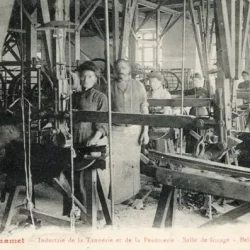
Mazamet and the tradition of sheepskin leather: a historic part of France’s leather heritage.
👉 Discover the artisanal craftsmanship behind the club chair
👉 Learn more about club chair leather
How to recognize a genuine antique club chair
The club chair market today includes antique pieces, restored chairs, reproductions, and more or less faithful reinterpretations. Knowing how to recognize a genuine antique club chair helps avoid confusion and better understand the value of a model.
A low, enveloping silhouette
An authentic antique club chair generally features compact proportions, a deep seat, and a low backrest. Its shape immediately conveys comfort and substance. The armrests are full, the curves natural, and the whole piece has real presence.
Thick leather with a natural patina
A genuine antique club chair often shows harmonious signs of wear: tonal nuances, creases, slight surface wear, and color variation. This patina should not be confused with an artificially distressed finish. Quality antique leather remains supple while telling its own story.
A substantial weight and a serious structure
Real antique club chairs are often heavy. This density comes from the solid wood frame, traditional padding, and the overall quality of construction. A club chair that feels too light may indicate a newer or more economical build.
Consistent craftsmanship details
Seams, finishes, the way the leather fits the frame, the quality of the padding, and the regularity of the volumes all offer clues. On artisanal models, nothing feels fragile or improvised. The chair instead gives an impression of evidence, balance, and solidity.
👉 Read our guide to the antique club chair
Antique club chair or modern reproduction?
Choosing between an antique club chair and a modern reproduction depends on your budget, the level of authenticity you want, the comfort you expect, and the intended use. Both options have real strengths when selected carefully.
The advantages of an antique club chair
- A unique patina that cannot truly be replicated
- Historic charm and strong decorative character
- A sense of heritage
- The possibility of restoration and transmission
An authentic antique club chair attracts those who love living pieces, furniture with history, and singular interiors. It may, however, require restoration or refurbishment depending on its condition.
The advantages of a high-quality new club chair
- A sound structure and immediate comfort
- A wider choice of dimensions and finishes
- Easier adaptation to a specific interior
- Less uncertainty about the condition of the padding or leather
A well-made modern reproduction can offer excellent comfort, beautiful leather quality, and an aesthetic faithful to the original spirit. Everything depends on the seriousness of the craftsmanship.
| Criteria | Antique club chair | New club chair |
|---|---|---|
| Patina | Natural and unique | Will develop over time |
| Immediate comfort | Varies depending on condition | Usually more predictable |
| Authenticity | Very high | Depends on craftsmanship |
| Maintenance / restoration | May be required | Less urgent in the short term |
| Customization | Limited to the model found | Wider choice of finishes |
The main club chair styles
The club chair is not limited to a single silhouette. Over time, several styles emerged, each with its own proportions, details, and decorative personality.
The classic club chair
This is the best-known model. It features rounded, generous, and balanced shapes. It embodies the most traditional image of the French club chair.
The moustache club chair
Highly sought after, this model stands out for the distinctive shape of its backrest, which resembles a moustache or a more elegantly curved line. It has a strong visual personality.
The policeman’s hat club chair
Its backrest draws a structured and elegant curve. This is a club chair style appreciated for its refinement and its stronger decorative presence.
The Art Deco club chair
More geometric and sometimes more upright, it reflects the influence of the 1920s and 1930s on furniture design. It appeals to interiors seeking a balance between vintage spirit and graphic sophistication.
Rarer or derived models
You can also find bridge-style club chairs, aviator versions, forms inspired by English clubs, or more understated contemporary interpretations. Not all of them have the same historical legitimacy, but they show the richness of the club chair universe.
Club chair vs. other armchairs
To understand what makes the club chair so unique, it is helpful to compare it with other major families of armchairs.
- Chesterfield armchair: more formal, often tufted, visually more stately but generally less enveloping in feel.
- Scandinavian armchair: visually lighter and more airy, but often less deep and less warm in material.
- Contemporary armchair: sleek design, sometimes very attractive, but not always designed for the same long-lasting comfort.
- Club chair: a rare balance of comfort, character, noble material, and durability.
The club chair stands apart above all in its relationship to time. It does not try to impress through a spectacular visual effect. It convinces through presence, softness of use, substance, and its ability to become more beautiful over the years.
Why is a club chair expensive?
The price of a club chair can come as a surprise when compared with standardized armchairs. Yet that price is clearly explained by the quality of the materials, the complexity of the craftsmanship, and the product’s exceptional lifespan.
The cost of leather
Beautiful leather represents a significant part of the final price. Full-grain leather or fine sheepskin leather has nothing in common with corrected or synthetic coverings. The raw material is more noble, more durable, and far more beautiful over time.
Artisanal work
An artisanal club chair requires time, precision, and real expertise. Cutting the leather, fitting it, padding the chair, balancing the volumes, and refining the finishes are not part of ordinary industrial production. In specialized workshops, each chair requires genuine care.
The structure and durability
A high-quality club chair is not a disposable purchase. Its solid wood frame, thick leather, and well-designed comfort allow it to last for many years, even several decades. When measured against its lifespan, its cost takes on a very different meaning.
The possibility of restoration
Unlike many contemporary pieces of furniture, the club chair can be restored, repadded, re-waxed, or repaired. This repairability increases both its practical value and its heritage appeal.
The club chair in interior design
The club chair has strong decorative power. It can become an anchor point in a room, structure a reading area, or warm up an interior that feels too smooth or cold. Its material and shape allow it to fit naturally into many styles.
In a classic living room
It naturally extends the spirit of beautiful materials, warm tones, bookcases, thick rugs, and carefully chosen objects.
In an industrial interior
Aged leather, black metal, raw wood, and textured walls pair perfectly with a vintage leather club chair. It then becomes a strong, authentic focal point.
In a contemporary setting
Used as a contrast in a more minimalist interior, the club chair brings depth, texture, and warmth. It softens any coldness an overly clean-lined space may have.
In an office or library
This is perhaps the setting in which it expresses its personality best. Reading, soft light, quiet, and aged leather: the club chair feels naturally at home in this world.
Why the club chair is timeless
Very few pieces of furniture can claim to last more than a century without losing their relevance. If the club chair remains so desirable today, it is because it brings together qualities that are rarely united in one object.
- It is comfortable: its deep seat answers a universal and lasting need.
- It is strong: its structure and materials make it a long-term piece of furniture.
- It becomes more beautiful with age: its patina tells the story of use instead of hiding it.
- It has a true identity: it is instantly recognizable.
- It escapes fast trends: it moves through them instead of being ruled by them.
The club chair does not depend on novelty. Its strength comes from consistency. It remains desirable because it answers deep expectations: comfort, authenticity, material, presence, and transmission.
How to choose a club chair today
Choosing a club chair is not simply about finding a beautiful shape. You need to assess the quality of the leather, the comfort, the dimensions, the craftsmanship, and how well it fits your interior.
1. Choose beautiful leather
Leather is at the heart of the experience. Whenever possible, choose full-grain leather, aniline leather, or quality sheepskin leather. Good leather should have depth, a rich visual presence, and the ability to age beautifully.
2. Check the quality of comfort
The club chair should feel enveloping without being too soft. Seat depth, padding density, and back support are essential.
👉 Read our guide to choosing a comfortable club chair
3. Check the dimensions
A club chair that is too large can weigh down a room, while a model that is too compact may lose comfort. You need to consider available space, circulation, and real-life use.
👉 See the guide to club chair dimensions
4. Look closely at the craftsmanship
A solid wood frame, leather that holds beautifully, clean finishes, and balanced proportions: a quality club chair inspires confidence at first glance.
5. Think about care and durability
Well-maintained leather keeps its suppleness and beauty for longer. It is better to choose a chair that can be nourished, cared for, and allowed to age properly.
👉 See our leather club chair care guide
👉 See the complete guide to choosing a club chair
The club chair: much more than just an armchair
The club chair is not simply an antique leather armchair or a classic piece of interior design. It is an object of domestic culture. It tells the story of a time when comfort truly began to matter. It reflects craftsmanship, demanding materials, and a relationship to time that very few contemporary pieces of furniture can still offer.
More than a seat, the club chair is a presence. A piece of furniture that ages with you, grows more beautiful over the years, and passes through generations without losing its soul. It is this rare combination of comfort, character, nobility, and longevity that explains why it remains, even today, one of the most desirable icons of French furniture.
Looking for a genuine artisanal club chair?
Discover our leather models, crafted in keeping with tradition and designed to last while developing an elegant patina over time.
FAQ – Everything You Need to Know About the History of the Club Chair
What is the origin of the club chair?
The club chair appeared in France at the beginning of the 20th century, at a time when comfort was becoming a priority in interior design. It marked a clear break from the more rigid seating of the 19th century by offering an upholstered, welcoming structure designed for everyday use.
Why is the club chair almost always made of leather?
Leather became the preferred material because of its durability, suppleness, elegance, and ability to develop a patina over time. It protects the structure of the chair while giving it a living, authentic appearance.
Is the club chair a French piece of furniture?
Yes. The club chair as we know it is deeply linked to the history of French furniture. Although the world of English clubs influenced its imagery, its spread, style, and artisanal development are strongly rooted in France.
How can you recognize an authentic antique club chair?
You can identify one by its low, enveloping silhouette, its thick naturally aged leather, its heavy solid wood frame, and the consistency of its finishes. A genuine antique club chair conveys solidity, comfort, and character all at once.
What is the difference between an antique club chair and a reproduction?
An antique club chair offers a unique patina and authenticity, but it may require restoration. A high-quality modern reproduction, on the other hand, offers a sound structure, immediate comfort, and sometimes more options in terms of dimensions and finish.
What are the most famous club chair styles?
The best-known styles are the classic club chair, the moustache model, the policeman’s hat model, and certain Art Deco versions. Each reflects a particular aesthetic evolution of the club chair.
Why is a club chair expensive?
Its price is explained by the quality of the leather, the strength of the frame, the level of artisanal craftsmanship, the comfort of the padding, and its long lifespan. It is a piece of furniture designed to last much longer than a standard armchair.
Is the club chair still fashionable today?
Yes, more than ever. The return of vintage style, the interest in noble materials, and the search for durable furniture have renewed enthusiasm for the club chair, both in classic and contemporary interiors.
How long can a club chair last?
A high-quality club chair can last for several decades. Thanks to its solid wood frame, thick leather, and the possibility of restoration, it can even be passed down from one generation to the next.
Does the club chair suit a modern interior?
Yes. It works beautifully in a contemporary setting by bringing warmth, texture, and an elegant contrast to cleaner, more minimal lines.
What leather should you choose for a club chair?
The most appreciated leathers are full-grain leather, aniline leather, and sheepskin leather. They offer a more noble feel, better long-term performance, and a more authentic patina.
Is it better to buy a new or restored club chair?
That depends on your project. A restored model offers the charm of the past and strong personality. A high-quality new model guarantees immediate comfort, an impeccable structure, and an easier choice when it comes to dimensions or finish.